8 Best Mini Die Cutting Machines for Card Making (November 2026)
The best mini die cutting machines for card making include the Find Scrapblooms 6inch Manual Die Cutting Machine Kit for A5 card panels, the BAOFALI Mini Manual Die Cutting and Embossing for travel and storage, and the CraftGenes 6 Inch Manual Die Cutting (best starter kit for card makers).
On this page (10 sections)
- The best mini die cutting machines for card making
- How these mini die cutting machines compare
- How we compared these mini die cutting machines
- Which opening size do you need for card making?
- Do you want a kit or just the machine?
- What plate stacks and material limits should you watch?
- Should you buy manual or electric for card making?
- Are the smallest mini machines worth it for cards?
- The best manual die cutting machines for bigger batches
- Which mini die cutting machine should you buy?
The best mini die cutting machine for card making is the Find Scrapblooms 6inch Manual Die Cutting Machine Kit, because its 6-inch opening takes A5 cardstock and the plate stacking is spelled out for both cutting and embossing. Pick a smaller unit only if desk space or travel matters more than A5 coverage.
A mini die cutting machine for card making sits between a full-size manual press and a tiny tag maker. The 6-inch models here cut and emboss folded card fronts, while the 3.5-inch and 2.5-inch units handle accents and small dies.
If you're still weighing manual against electric, our best die cutting machine for card making guide covers the whole field. For machines without a crank, see our roundup of electronic die cutting machines.
Our picks at a glance
-
1
 Best for A5 card panels
Find Scrapblooms 6inch Manual Die Cutting Machine Kit
9.7/10 our score
See it on Amazon -
2
 Best for travel and storage
BAOFALI Mini Manual Die Cutting and Embossing
8.9/10 our score
See it on Amazon -
3
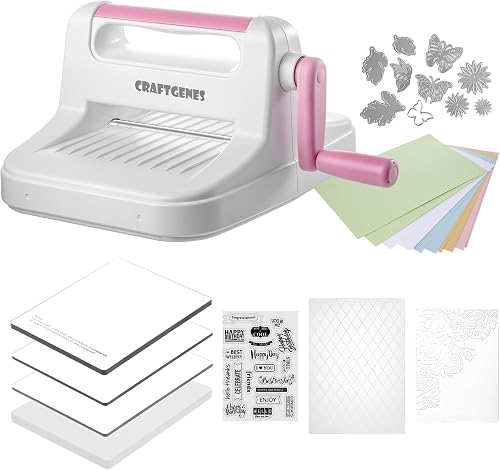 Best starter kit for card makers
CraftGenes 6 Inch Manual Die Cutting
8.7/10 our score
See it on Amazon
- 4
 Check it
CYFUN DESIGN Mini Die Cutting Machine
Best for small die cuts and accents - 5
 Check it
Genron Craft Manual Die Cutting Machine for Card
Best for small craft rooms - 6
 Check it
CraftGenes Mini Die Cutting & Embossing Machine
Best for tags and tiny accents - 7
 Check it
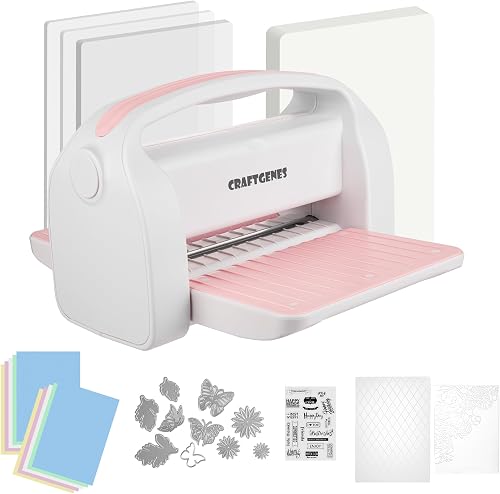
CraftGenes 9-Inch Die Cutting and Embossing Machine
Best for full card bases and larger panels - 8
 Best for Sizzix die compatibilityCheck it
The best mini die cutting machines for card making
The top pick covers most card makers, and each pick below solves a specific problem: A5 coverage, kit contents, small desk space or die compatibility. Buy by the size of the panels you cut, not by the number of accessories.
Find Scrapblooms 6inch Manual Die Cutting Machine Kit: Best for A5 card panels
- 6-inch opening for A5 cardstock
- 12.2 x 12.2 x 6.7 in body
- Carbon steel and ABS build
- No power needed
A 6-inch opening that takes A5 cardstock, with plate recipes printed for both die cutting and embossing so a beginner can start without guessing.
Pros
- A5-sized opening for folded card fronts
- Clear plate stacking for cutting and embossing
- Works without an outlet
Cons
- Carbon steel body makes it heavier than the 3.5-inch units here
Find Scrapblooms suits a card maker who wants A5 coverage and a known plate recipe from the first session. Its 6-inch opening takes A5 cardstock, and the instructions give one stack for embossing and another for die cutting.
The active surface is 44 square inches, so a folded card front fits without tilting the stack. The build is carbon steel inside with an ABS shell.
The embossing stack is a 13mm plate, two 3mm PC plates and the folder with paper inside. For die cutting it's a 13mm plate, a 5mm PC plate, paper, the die and a 3mm PC plate.
Write those two lines on a card and keep it with the machine.
The trade-off against the 3.5-inch units here is size and weight: the steel frame takes more shelf space and feels heavier to move. That's the price of A5 coverage.
BAOFALI Mini Manual Die Cutting and Embossing: Best for travel and storage
- 6.3 x 3.8 x 3 in body
- 18.6 square inch active area
- Built-in suction base
- Two plastic cutting mats
The smallest footprint in this group, sized for a drawer or a craft bag rather than a permanent desk spot.
Pros
- Very compact body
- Suction base holds it steady
- Cuts tissue paper, foils and acetate ribbon
Cons
- Active area is too small for a full A5 card front
BAOFALI suits crafters who need a machine that lives in a drawer and comes out for an evening of small die cuts. At 6.3 x 3.8 x 3 inches it's the smallest body in this group, and the active area is 18.6 square inches.
The suction base is the practical detail. On a smooth table the machine grips instead of sliding while you turn the handle.
Two plastic mats, one 3mm and one 4mm, come with it.
It's listed for tissue paper, foils, acetate ribbon and thin leather, so it's better for layered accents than for a thick card base. Load the stencil and cardstock between the two mats and turn the handle.
The trade-off is coverage. An 18.6 square inch area won't take a full A5 panel, so plan on using it for small dies while a 6-inch machine handles the card front.
If your cards are mostly tiny shapes and sentiments, that limit won't matter.
CraftGenes 6 Inch Manual Die Cutting: Best starter kit for card makers
- 6-inch opening for A5 cardstock
- Plates, two embossing folders and two die sets
- Stamp set and 10 cardstock sheets
- Magnetic sheets included
A 6-inch kit with enough plates, folders, dies and stamps to make a first batch of cards without buying anything else.
Pros
- Dies, folders, stamps and cardstock in the box
- Magnetic sheets help hold dies
- Illustrated cutting and embossing stacks
Cons
- Plain cardstock up to 240 gsm only, no adhesive-backed or laminated sheets
CraftGenes suits a beginner who wants to make cards the day the box arrives. The kit includes a 13mm base plate, two 2.85mm B plates, a 5mm C plate, a 0.3mm shim, two magnetic sheets, two embossing folders, two die sets, 10 cardstock sheets and a stamp set.
The 6-inch opening takes A5 cardstock for card fronts, invitations and gift tags. The active area is 6 x 9 inches, a useful shape for panels wider than they are tall.
The clear illustrated stacks separate cutting from embossing.
Two warnings matter more than the extras. It's built for plain, uncoated cardstock up to 240 gsm, so skip adhesive-backed paper, laminates, vinyl, vellum, fabric, leather and foils.
And keep the sandwich under about 22mm: if the handle feels stuck, reverse it and remove a shim rather than forcing it.
Against the top pick, this one gives you more to start with but a narrower material range. Choose it if you want dies and folders in the box; choose Find Scrapblooms if you already own supplies and want the simplest plate recipe.
CYFUN DESIGN Mini Die Cutting Machine: Best for small die cuts and accents
- Accepts dies within 3 x 4 inches
- Paper thickness 80 to 250 gsm
- Two cutting pads included
- Suction base
A compact crank machine aimed at small dies and card accents, with a stated paper range that covers most everyday cardstock.
Pros
- Handles 80 to 250 gsm paper
- Two cutting pads included
- Cuts and embosses
Cons
- Dies wider than 3 x 4 inches won't fit
CYFUN DESIGN suits card makers whose dies are small shapes and sentiments. It takes dies within 3 x 4 inches and paper from 80 to 250 gsm, which covers most everyday cardstock without going near the thick stuff.
The crank handle applies even pressure, so small dies cut cleanly without a second pass. Two cutting pads come in the box, and the base has an anti-skid pad to keep the unit in place.
The 250 gsm upper limit is the highest in this roundup, so heavier plain cardstock is workable here where the CraftGenes 6 Inch kit stops at 240 gsm. It's also a genuinely small machine, so it earns its desk space.
The trade-off is die size. Anything wider than 4 inches won't fit, so large background dies and full-panel embossing folders belong on a 6-inch or 9-inch machine.
Buy this one as a second machine for accents, or as your only machine if your dies are all small.
Genron Craft Manual Die Cutting Machine for Card: Best for small craft rooms
- 6-inch opening
- Foldable handle
- Built-in storage compartment
- Embossing folder, dies, cardstock and stamps
A 6-inch machine with a handle that folds down and a lid compartment for dies and small tools, which keeps a shared desk clear.
Pros
- Foldable handle for storage
- Storage compartment under the platform cover
- Starter accessories included
Cons
- Weighs 8.8 lb, more than the compact mini machines here
Genron Craft suits a shared desk or a small craft room where the machine has to disappear between sessions. The handle folds down and the platform cover lifts to reveal a storage compartment for dies, mini folders, tweezers and paper scraps.
The 6-inch opening handles standard cardmaking sizes, and the kit includes an embossing folder, a cutting die set, a pack of cardstock and a set of clear stamps. Cutting and embossing both run off the same machine.
It weighs 8.8 pounds, so it's a sit-down machine rather than a carry-along. In return you get the built-in storage, which is the feature the other 6-inch picks lack.
That compartment is the reason to choose it over the CraftGenes kit.
If you want a machine in a tote bag, the BAOFALI or CraftGenes 3.5-inch units are lighter. Buy this one when the machine gets a permanent spot.
CraftGenes Mini Die Cutting & Embossing Machine: Best for tags and tiny accents
- 3.5-inch feed slot, paper up to 3 inches wide
- 24 accessories including 3 plates and 3 folders
- Built-in storage
- 5.9 x 5.9 x 3.15 in body
The smallest feed slot here, made for small metal dies and card details rather than a full card front.
Pros
- Built-in storage for dies and tools
- 24 accessories in the kit
- Compact 5.9-inch body
Cons
- 3-inch paper limit rules out A5 panels
CraftGenes' 3.5-inch kit suits tag makers, card accents and scrapbook details. The feed slot takes paper up to 3 inches wide, so a tag or a small die cut fits while a full card front does not.
The kit is the story here: 3 cutting plates, 3 embossing folders, 1 die set, 7 stamps, 10 cardstock sheets and the machine, plus an instruction guide. The body is 5.9 x 5.9 x 3.15 inches with built-in compartments and a top handle for storage and travel.
It's built for small thin metal dies, standard cardstock and plain paper. Oversized dies, laminated sheets and thick materials are outside its range.
Rotate and flip the plates to spread the wear.
The trade-off against the 6-inch machines is obvious: a 3-inch paper limit rules out A5 panels. Buy it if your cards lean on small layered shapes, or as a second machine for accents next to a bigger press.
It's the lightest kit here for taking to a class.
CraftGenes 9-Inch Die Cutting and Embossing Machine: Best for full card bases and larger panels
- 9 x 12 in active area
- Foldable side panels
- Manual crank, no power needed
- A4 and larger paper
A 9-inch machine for card makers who also cut journal pages and larger panels, with side panels that fold in when the desk needs clearing.
Pros
- 9 x 12 in active area
- Foldable side panels save space
- Handles A4 paper and larger
Cons
- Bigger than a true mini machine and needs more desk room
CraftGenes' 9-inch model suits card makers who also cut journal pages, larger panels and seasonal projects. The active area is 9 x 12 inches, and it's designed for A4 paper and larger, so it goes well beyond a folded card front.
The side panels fold in when the machine isn't in use, which makes it easier to store than a fixed 9-inch press. It's still a manual crank with no electricity, so the pressure comes from your hand.
The plate order for embossing is a 13mm plate, a 3mm cutting plate, the folder and a 3mm plate, with the folder set back 1 cm. For die cutting it's a 13mm plate, a 3mm plate, a 2mm plate, paper, the die and a 3mm plate.
That's more layers than the 6-inch kits, so keep the instructions close.
It's the largest machine in this roundup and not really mini. The trade-off is desk space for coverage.
Buy it if you cut A4 and larger regularly; skip it if cards are your only project.
Sizzix Sidekick Starter Kit: Best for Sizzix die compatibility
- 2.5-inch opening
- Sizzix Thinlits and Framelits compatibility
- Vacuum seal base
- Weighs 2 lb
A 2.5-inch roller machine for Sizzix thin dies and small embossing folders, with a vacuum base to hold it still.
Pros
- Works with Sizzix Thinlits and Framelits dies
- Vacuum base for stability
- Light 2 lb body
Cons
- 2.5-inch opening limits you to small dies and folders
Sizzix's Sidekick suits crafters who already own Sizzix dies. Its 2.5-inch opening takes Thinlits and Framelits dies and embossing folders up to 6.35 cm wide, and the description says other brands' thin dies work too.
That compatibility is the reason to pick it over the unbranded minis.
The vacuum seal base holds the machine to any smooth work surface, which helps when you're cutting at a table that isn't yours. It weighs about 2 pounds and measures roughly 7 3/4 x 4 3/4 x 3 1/2 inches, so it travels well.
The kit includes six Framelits dies, two Thinlits dies, two small Textured Impressions embossing folders and seven stamps. For a Sizzix user that's a useful first set of dies rather than filler.
At 2.5 inches it's the smallest opening here, so card fronts are out and small dies are the job. Buy it if Sizzix dies fill your drawer; otherwise a 6-inch kit gives you more room for the same crank effort.
How these mini die cutting machines compare
The comparison table shows what separates these machines: opening size, active area, operation and what comes in the box. Read it by the size of the panels you cut, then by kit contents.
| Product | Best for | Opening | Active surface area | Operation | Our score |
|---|---|---|---|---|---|
| Find Scrapblooms 6inch Manual Die Cutting Machine Kit | A5 card panels | 6 in (A5 cardstock) | 44 square inches | Manual crank | 9.7 |
| BAOFALI Mini Manual Die Cutting and Embossing | travel and storage | Small mini format | 18.6 square inches | Manual crank | 8.9 |
| CraftGenes 6 Inch Manual Die Cutting | starter kit for card makers | 6 in (A5 cardstock) | 6 x 9 in | Manual crank | 8.7 |
| CYFUN DESIGN Mini Die Cutting Machine | small die cuts and accents | Mini format | Manual crank | 8.6 | |
| Genron Craft Manual Die Cutting Machine for Card | small craft rooms | 6 in | 6 in | Manual crank | 8.4 |
| CraftGenes Mini Die Cutting & Embossing Machine | tags and tiny accents | 3.5 in | 3.5 x 7.08 in | Manual crank | 8.2 |
| CraftGenes 9-Inch Die Cutting and Embossing Machine | full card bases and larger panels | 9 in | 9 x 12 in | Manual crank | 8.0 |
| Sizzix Sidekick Starter Kit | Sizzix die compatibility | 2.5 in | 81.05 square cm | Manual crank | 7.9 |
How we compared these mini die cutting machines
We compared opening sizes, plate stacks, included accessories and material limits from the product data, then weighed each machine against what a card maker actually cuts. Our score weighs specs, features and buyer feedback against what you're shopping for.
Opening size came first, because it decides whether a machine can take an A5 card front. A 6-inch opening covers standard cardmaking sizes; a 9-inch opening adds A4 panels; a 3.5-inch or 2.5-inch slot limits you to small dies and accents.
Plate stacks came second. A kit that prints separate recipes for cutting and embossing is easier for a beginner than one that leaves you to work it out.
Shims and magnetic sheets matter too, since they let you fine-tune pressure without forcing the handle.
Included accessories decided the value ranking among the 6-inch machines. The CraftGenes kit brings dies, folders, stamps and cardstock; the Find Scrapblooms kit assumes you own supplies and keeps the recipe simple.
Material limits set the honest ceiling on each machine. The CYFUN DESIGN takes 80 to 250 gsm paper, the CraftGenes 6 Inch kit is built for plain cardstock up to 240 gsm, and the Sizzix Sidekick is aimed at thin dies.
A machine with a lower limit won't handle thick card bases well.
We also weighed portability. A carbon steel 6-inch machine with a fixed handle sits on a desk; a 2-pound or 3-inch unit with a suction base goes in a bag.
That's a real choice, not a tie.
Which opening size do you need for card making?
Six inches is the size most card makers need, because it takes A5 cardstock and covers a folded card front. Go smaller only if your projects are accents and tags; go to 9 inches only if you also cut A4 and larger panels.
6-inch machines for A5 card fronts
The Find Scrapblooms kit, the CraftGenes 6 Inch kit and the Genron Craft all list a 6-inch opening. That's the sweet spot for greeting cards, invitations, gift tags and scrapbook pages.
If you make cards most weeks, start here. A 6-inch machine does the card front and the accent dies in one pass, so you don't need a second unit for small shapes.
3.5-inch and 2.5-inch machines for small dies and accents
The CraftGenes 3.5-inch kit takes paper up to 3 inches wide, and the Sizzix Sidekick opens to 2.5 inches. These suit tag making, card accents and layered details, and they store in a drawer.
Choose one as your only machine only if your cards are built from small shapes. Otherwise they work best as a second machine beside a 6-inch press.
9-inch machines when cards share the desk with journals
The CraftGenes 9-Inch model has a 9 x 12 inch active area and handles A4 paper and larger. That's more than cards need, but it covers journal pages and large panels on the same machine.
If your card making sits alongside scrapbooking and journaling, the extra coverage pays for itself. If cards are the whole job, a 6-inch machine takes less desk space.
Do you want a kit or just the machine?
A kit saves a first shopping trip, while a bare machine makes sense if you already own plates, dies and folders. The best choice depends on what's already in your craft drawer.
Starter kits with dies, folders and cardstock
The CraftGenes 6 Inch kit includes plates, two embossing folders, two die sets, 10 cardstock sheets, a stamp set and instructions. The Genron Craft kit includes an embossing folder, a cutting die set, cardstock and clear stamps.
The Sizzix Sidekick kit includes Framelits, Thinlits, small embossing folders and stamps.
Kits matter most for a beginner who doesn't yet know which plates a machine needs. The included plate set also tells you the stack the maker expects, which is safer than guessing.
Bare machines when you already own the supplies
The Find Scrapblooms kit lists the die cutting machine as its included component and prints the plate recipes in the instructions. That's the right buy if you already own plates or you buy dies and folders separately.
Check that your existing plates match the opening and stack height before you buy. A plate set from a 9-inch machine won't fit a 6-inch opening in the right order.
What plate stacks and material limits should you watch?
Follow the plate order the instructions give for each job, and keep the stack within the maker's height limit. For the CraftGenes 6 Inch kit that limit is about 22mm, and a stuck handle means the stack is too thick.
Cutting and embossing use different stacks
For the Find Scrapblooms kit, embossing is a 13mm plate, two 3mm PC plates and the folder with paper inside. Die cutting is a 13mm plate, a 5mm PC plate, paper, the die and a 3mm PC plate.
Write your machine's two recipes down. A card maker switching between cutting and embossing several times in one session will otherwise lose track of which plate goes where.
Cardstock weight and material limits
CraftGenes builds its 6 Inch kit for plain, uncoated cardstock up to 240 gsm and warns against adhesive-backed paper, laminates, vinyl, vellum, fabric, leather and metallic foils. The CYFUN DESIGN lists paper from 80 to 250 gsm.
The BAOFALI lists tissue paper, foils, acetate ribbon and thin leather.
Stay inside the listed range. A thicker stack can jam the crank or mark the plates, and forcing the handle is the fastest way to damage a machine.
Light scratches on clear plates are normal; flip and rotate them to spread the wear.
Should you buy manual or electric for card making?
Buy manual if you cut a few cards at a time and want no cord, no outlet and full control over each pass. Electric suits batch production and repeated identical cuts.
Every machine in this roundup is manual.
When a manual mini machine is the better buy
A manual crank gives you direct feel for the pressure. You stop the moment a stack feels tight, which protects the plates and dies.
It also works anywhere: kitchen table, craft class or a friend's house.
For card making in small batches, that control matters more than speed. The 6-inch manual machines here cut a card front in one pass and emboss a background in the next.
When to look at electric die cutting machines
Electric models earn their space when you cut the same shape dozens of times for invitations or craft fair stock. They take the crank work out of the session and keep pressure consistent from the first pass to the last.
If that's your pattern, compare the options in our electric die cutting machines for card making guide before settling on a manual unit. For most home card makers, a manual mini machine plus a good die collection is the simpler setup.
Are the smallest mini machines worth it for cards?
Yes, if your cards are built from small dies and accents. A 2.5-inch or 3.5-inch machine cuts those cleanly and stores in a drawer.
No, if you want to cut a full A5 card front, because the slot is too narrow.
What a 2.5-inch or 3.5-inch opening can and can't do
The Sizzix Sidekick takes Thinlits and Framelits dies and folders up to 2.5 inches wide. The CraftGenes 3.5-inch kit takes paper up to 3 inches wide.
Both handle tags, small shapes and layered details well.
Neither takes a full card front. If your design puts a small die-cut shape on a plain A5 panel, that's fine.
If you want to cut the panel itself into a shape, you need a 6-inch opening.
Pairing a small machine with a 6-inch press
The practical setup for a busy card maker is a 6-inch machine for panels and a small unit for accents. The small unit stays out on the desk with its most-used dies in its storage compartment, while the bigger press handles backgrounds and embossing.
That pairing costs more than one machine. Buy a single 6-inch kit first if you're starting out, then add a small unit once your die collection grows.
The best manual die cutting machines for bigger batches
If card making grows into a regular hobby with bigger batches, a full-size manual press covers more ground than any mini unit here. Our roundup of the best manual die cutting machines compares the larger crank models on opening size, plate stacks and price tier.
A full-size press takes a whole card base and larger embossing folders in one pass. It also weighs more and takes a permanent spot.
Make the move when your mini machine is the bottleneck, not before.
Which mini die cutting machine should you buy?
Buy the Find Scrapblooms 6inch kit if you make A5 cards and want a known plate recipe from day one. It's the best mini die cutting machine for card making overall, because the 6-inch opening and the two printed stacks cover the whole job.
Pick the CraftGenes 6 Inch kit if you'd rather have dies, folders, stamps and cardstock in the box. Choose the BAOFALI or the CraftGenes 3.5-inch kit for travel and drawer storage.
The CYFUN DESIGN is the one for 3 x 4 inch dies and heavier plain cardstock, and the Sizzix Sidekick is the right call if Sizzix dies fill your collection. The CraftGenes 9-Inch model is the step up when cards share the desk with journals and A4 projects.
Start with your largest die and your usual card size. If both fit a 6-inch opening, the top pick is the simplest machine that does the job.
If you cut A4 panels or large folders, move up to the 9-inch model.
Our top 3 picks at a glance
-
1
Best for A5 card panels
Find Scrapblooms 6inch Manual Die Cutting Machine Kit
9.7/10 our score
See it on Amazon -
2
Best for travel and storage
BAOFALI Mini Manual Die Cutting and Embossing
8.9/10 our score
See it on Amazon -
3
Best starter kit for card makers
CraftGenes 6 Inch Manual Die Cutting
8.7/10 our score
See it on Amazon
Frequently asked questions
What size opening do I need for A5 cards?
A 6-inch opening takes A5 cardstock, which covers most folded card fronts and layers. The Find Scrapblooms kit, CraftGenes 6 Inch kit and Genron Craft all list a 6-inch opening.
A 3.5-inch or 2.5-inch machine only takes small dies and accents.
Do mini die cutting machines need electricity?
No. Every machine in this roundup runs on a hand crank.
That means no outlet, no batteries and no cord, so you can work at a kitchen table or on the sofa.
The trade-off is that you turn the handle yourself for each pass.
Can these machines emboss as well as cut?
Most of them do both. The plate stacks differ for cutting and embossing, so follow the order the instructions give for each job.
The Find Scrapblooms kit and the CraftGenes 6 Inch kit both print separate recipes for the two tasks.
What cardstock works in a mini die cutting machine?
Plain cardstock up to about 240 gsm is the safe range for the 6-inch kits here. CraftGenes warns against adhesive-backed paper, laminated sheets, vinyl, vellum, fabric, leather and metallic foils.
Check your cardstock weight before stacking plates.
Can I use my existing dies in a mini machine?
It depends on die size. The CYFUN DESIGN takes dies within 3 x 4 inches.
The Sizzix Sidekick takes Thinlits and Framelits plus other brands' thin dies up to 2.5 inches wide.
Measure your largest die before buying a small machine.
How thick should the plate sandwich be?
CraftGenes puts the recommended stack at about 22mm for its 6 Inch kit. If the handle feels hard to turn, stop and remove a shim rather than forcing it.
Plate thickness varies by machine, so use the stack your instructions list.


